I was speaking with an attorney a couple weeks ago and the topic of wind turbines came up. He is representing the local opposition to wind turbine construction. One of the big worries of wind turbine opponents is the effects of low frequency sound. These are sounds between the range of 10 -200 Hz (sound below 20 Hz is called infrasound). Infrasound is not heard by most people but that doesn't mean it isn't sensed at all. It seems there is room for research on the topic of effects of infrasound on humans. It appears that a small percentage of the population might be more sensitive to low frequency sound (abstract here).
A list of review papers on effects of low frequency sound here.
White paper on wind turbine noise here.
Powerpoint presentation on infrasound and noise perception here.
Calculate the wind turbine noise on your property here (maybe only works for UK?).
Wind Turbine Sound calculator from Denmark here and sound map here.
Study on who is annoyed by wind turbine noise and why here.
Wind power opposition here.
Article by Nina Pierpont, local anti-wind turbine activist, here.
Will Kinney, physicist, calls it junk science (at least he doesn't list his academic degrees after his name everytime it is written).
Everything you want to know about why wind power is bad here.
UPDATE: I want to point out that I am in favor of wind generated power in the North Country. I think the advantages far outweigh the disadvantages.
Tuesday, December 19, 2006


Poinsettia Not Poisonous
Good Christmas news! Poinsettia (Euphorbia pulcherrima) ingestion can give an upset tummy if you eat enough of them and the sap irritates your skin, but they are not all that toxic. Also see this abstract in the American Journal of Emergency Medicine.
Monday, December 18, 2006
You Are One of the Richest People on Earth
Go to the Global Rich List and type in your income to find out where you stand in the world.
Let's say you are one of those Goldman Sachs people getting a $100 million dollar bonus. You would be in the top 0.001% richest people on earth or 107,565th richest person on earth.
Only make $18,000 a year? You are still in the top 11.6% of income earners.
Let's say you are one of those Goldman Sachs people getting a $100 million dollar bonus. You would be in the top 0.001% richest people on earth or 107,565th richest person on earth.
Only make $18,000 a year? You are still in the top 11.6% of income earners.
Who Would Join?
Tell me which group you would like to join and why.
The Trilateral Commission
The Illuminati
The Free Masons
Scientologists
The Rosicrucians
Skull and Bones
The Bilderberg Group
Knights of Pythias
El Yunque
The Trilateral Commission
The Illuminati
The Free Masons
Scientologists
The Rosicrucians
Skull and Bones
The Bilderberg Group
Knights of Pythias
El Yunque
More Sir Francis Galton F.R.S.
Sir Francis Galton has his own website. It's only right since he is the "Father of Statistics" and the cousin of Charles Darwin.
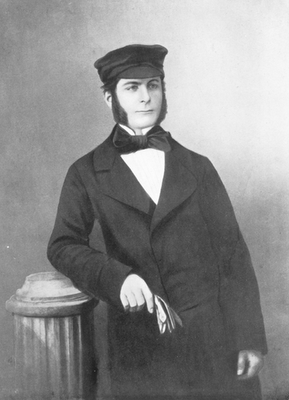
Here is young Sir Francis (age unknown). Still looks like me.
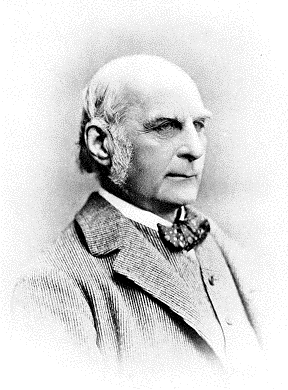
Here is old Sir Francis (age 73). Make up your own mind if it looks like me.
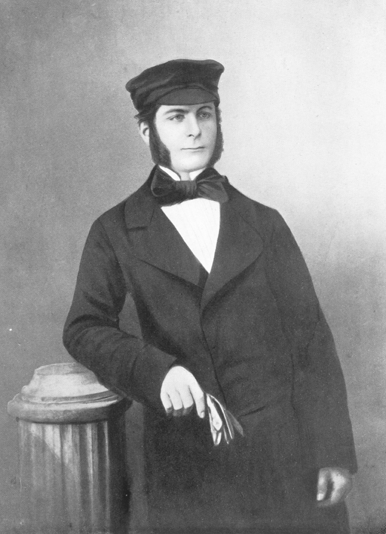
Here is young Sir Francis (age unknown). Still looks like me.

Here is old Sir Francis (age 73). Make up your own mind if it looks like me.

Friday, December 15, 2006

Pendragon Theatre and Carmelite Monastery

Photo from Historic Saranac Lake
Last night we attended a nice little reception at the above house located on Franklin Ave. in Saranac Lake. It's the former Carmelite Monastery, before that a private cure cottage owned by the Hudsons and now a vacation home. With the advent of anti-TB drugs it was no longer of use as a cure cottage. The house was given to the Carmelite Order of nuns. The nuns left Saranac Lake in 1998 and the house was sold to a private individual. Eighteen bedrooms, seven bathrooms, numerous fireplaces, a couple of kitchens and at least three staircases leading to the upper floors. The giant front living room was the previous chapel where Catholic Masses were held. One room for the public and another screened room for the nuns.
The reception was for friends of Pendragon Theatre. The owner of the house wrote a radio play called "A Franklin Manor Christmas" that was performed prior to the reception. The play was based on the new owners experiences in restoring the house.
Thursday, December 14, 2006
Body Worlds 2

Body Worlds 2 is in Boston until Jan. 7th. I am definitely going to go see it. This display has been a big hit in Europe and the people I know that have seen it have raved about it.
Not the "freepers" though. They see the exhibit as an abomination and a celebration of the "culture of death."
Nothing shocking about this, you say, it's just what passes for modern art these days? Ah, but there's an important difference. Von Hagens' "Bodyworks" exhibit is not representational art -- the usual paintings or sculptures or even photographs -- but actual human bodies or body parts from 200 dead men, women and children preserved, dissected, mutilated and put on display to entertain. [My emphasis]Ok, I'm pretty sure I will be entertained. But I'll be educated while I'm being entertained as well. The "freepers" are concerned whether consent was obtained from the persons whose bodies are used in the exhibit.
You would think the "freepers" would visit the Body Worlds website to obtain some information. Maybe they could even download the information concerning body donation (pdf file).
Von Hagens' purpose is simple: He wants to reduce the human body to a mere object. How better to do it than to take real bodies and defile, manipulate and pervert them from flesh and blood into plastic for the purpose of amusing those with a particularly ghoulish appetite? In the process, he goes way beyond objectification. He denigrates not only the human body but life itself.I guess I'll never understand the "freeper" mindset. The human body is something to be hidden, kept secret, not talked about. I really don't see how the "freepers" are any different than those that prevented human dissection in the dark ages. We certainly don't want anyone to learn the anatomy, physiology or health conditions of their bodies! "Freepers" must believe that there is no need for a person to understand their body. And the children! Think about the children! The exhibit is appropriate for 5th graders on up.
The River City Project
Teachers at Stafford Middle School in Plattsburgh, NY are requiring their students to go online to play a computer game. The game is part of the River City Curriculum Project out of Harvard University and supported by the National Science Foundation. Normally this wouldn't interest me all that much because I surely hope that computers are being used in school for more than keyboarding and wordprocessing. But it interests me for a few reasons.
First, the game takes place in the late 19th century in River City, USA. There's trouble in River City and it begins with a 'D' and ends with ease. It's the students job to find out what the heck is going on and how to solve the problems. Remember, this game takes place in an era where the germ theory of disease is just becoming an excepted theory.
The students interact with a reporter in River City named Kent Brock. Kent tells the students some things and asks them lots of questions that tests the students ability to explain, interpret, apply, give perspective, empathize and be self-aware. Students are allowed to review and critique Kent's articles before they go to press.
This sounds like it's far more than a game. It's almost like traveling back in time to obtain a real-life educational experience. It's a powerful tool because it uses "active learning" rather than passive learning. No one is lecturing you. You have to find out things on your own (with the help of other students in the multi-user environment). You can learn more about the active learning practices here at the Harvard active learning website.
BTW, there are 3 diseases attacking the good people of River City in 1890. Any guesses as to what these 3 diseases might be?
First, the game takes place in the late 19th century in River City, USA. There's trouble in River City and it begins with a 'D' and ends with ease. It's the students job to find out what the heck is going on and how to solve the problems. Remember, this game takes place in an era where the germ theory of disease is just becoming an excepted theory.
As visitors to River City, students travel back in time, bringing their 21st century skills and technology to address 19th century problems. River City is a town besieged with health problems. Students work together in small research teams to help the town understand why so many residents are becoming ill. Students use technology to keep track of clues that hint at causes of illnesses, form and test hypotheses, develop controlled experiments to test their hypotheses, and make recommendations based on the data they collect, all in an online environment.The objectives of this learning environment are 1) to learn the principles and concepts of science; 2) acquire the reasoning and procedural skills of a scientist; 3) devise and carry out investigations that test their ideas; 4) understand why such investigations are uniquely powerful.
The students interact with a reporter in River City named Kent Brock. Kent tells the students some things and asks them lots of questions that tests the students ability to explain, interpret, apply, give perspective, empathize and be self-aware. Students are allowed to review and critique Kent's articles before they go to press.
This sounds like it's far more than a game. It's almost like traveling back in time to obtain a real-life educational experience. It's a powerful tool because it uses "active learning" rather than passive learning. No one is lecturing you. You have to find out things on your own (with the help of other students in the multi-user environment). You can learn more about the active learning practices here at the Harvard active learning website.
BTW, there are 3 diseases attacking the good people of River City in 1890. Any guesses as to what these 3 diseases might be?
Tuesday, December 12, 2006
AAALAC
This is the "Association for Assessment and Accreditation of Laboratory Animal Care" or AAALAC. They are a non-profit, private organization that promotes the humane treatment of laboratory animals. This is all fine and good. It's an organization you can pay to insure that you are in compliance with state and federal regulations concerning the use of laboratory animals.
It's expensive to be a member of AAALAC. The fees are based on the square footage of your research facility. It's not clear if that means the area of the animal facility or the entire facility. The initial application fee is $3,200 - >$11,200. The annual fee is $2,100 - >$7,400. But the costs of complying with AAALAC recommendations can be much, much greater.
A copy of the "streamlined" program description can be found here (pdf). Basically, they want to know what you are doing with the animals and how you are doing it. How the animals are being housed, food or water restrictions etc. Fine, no problem. Who is your veterinarian (more costs)? What is your research funding? Next they want to know about health and hazard risks to personnel. How this relates to the humane treatment of animals is beyond me, but ok, let's hire a safety officer (more expense). BTW, the safety officer will ALWAYS ultimately tell you that the safety of personnel is up to the principal investigator.
Why do AAALAC inspectors need to come into your research lab? Syringe and needle inventory? Why should they care what chemicals you have on your shelves? What does that have to do with the humane treatment of lab animals?
AAALAC has a "Council of Accreditation" made up of "highly accomplished animal care and use professionals." Notice anything about their qualifications?
AAALAC does take the time to justify itself to researchers:
The real purpose of AAALAC is (1) to cover the butts of institute administrators; (2) to provide jobs for veterinarians that don't like working with animals and want to be administrators; (3) to give some sort of "cover" to investigators such that they can justify their humane use of experimental animals; (4) make it somewhat easier to apply for grants and publish research papers; (5) to find more and more ways they can insinuate themselves into the research process in order to insure continued existence of their organization.
Very little of what AAALAC does actually affects the health and humane treatment of laboratory animals. Unless file cabinet after file cabinet full of paper work somehow protects the animals.
It's expensive to be a member of AAALAC. The fees are based on the square footage of your research facility. It's not clear if that means the area of the animal facility or the entire facility. The initial application fee is $3,200 - >$11,200. The annual fee is $2,100 - >$7,400. But the costs of complying with AAALAC recommendations can be much, much greater.
A copy of the "streamlined" program description can be found here (pdf). Basically, they want to know what you are doing with the animals and how you are doing it. How the animals are being housed, food or water restrictions etc. Fine, no problem. Who is your veterinarian (more costs)? What is your research funding? Next they want to know about health and hazard risks to personnel. How this relates to the humane treatment of animals is beyond me, but ok, let's hire a safety officer (more expense). BTW, the safety officer will ALWAYS ultimately tell you that the safety of personnel is up to the principal investigator.
Why do AAALAC inspectors need to come into your research lab? Syringe and needle inventory? Why should they care what chemicals you have on your shelves? What does that have to do with the humane treatment of lab animals?
AAALAC has a "Council of Accreditation" made up of "highly accomplished animal care and use professionals." Notice anything about their qualifications?
AAALAC does take the time to justify itself to researchers:
If you're a researcher, you know that there are many regulations and requirements surrounding the use of animals in research. So at first glance, it may seem that participating in AAALAC's voluntary accreditation program is perhaps unnecessary—or just one more hurdle standing between you and your work.AAALAC benefits us, we are told, by eliminating variables, encouraging "performance-based" oversite and enhancing funding opportunities.
The real purpose of AAALAC is (1) to cover the butts of institute administrators; (2) to provide jobs for veterinarians that don't like working with animals and want to be administrators; (3) to give some sort of "cover" to investigators such that they can justify their humane use of experimental animals; (4) make it somewhat easier to apply for grants and publish research papers; (5) to find more and more ways they can insinuate themselves into the research process in order to insure continued existence of their organization.
Very little of what AAALAC does actually affects the health and humane treatment of laboratory animals. Unless file cabinet after file cabinet full of paper work somehow protects the animals.
Friday, December 08, 2006
The Limits of Medicine
That's the book I'm currently reading (ISBN 0-226-30207-5). It's about "how science shapes our hope for the cure." Dr. Ed Golub, a well know immunologist, tells us how we have given credit to medicine in improving our lives when the credit really belongs to other factors. Our lives have been extended, not primarily due to medical discoveries, but to public health. We live longer today because of sanitation, access to clean water, personal hygiene and a higher standard of living. I've only just gotten into the first few chapters. Dr. Golub does a really good job pointing out how until recently disease and early death were so pervasive that there was very little comment on it. It's just the way things were. In 17th century France one person in four died before his first birthday. Another one in four died before their 20th birthday and another quarter never reached the age of 45. Dr. Golub quotes Voltaire concerning Rousseau first visit to Paris in 1742.
"The strong smell of excrement pervaded the environment, and the stench of public places was both terrible and ceaselessly condemned. The vile smelling effluvia of the faubourg St.-Marcel de Justice, in the Louvre, in the Tuileries, at the Museum, even at the Opera...the quays revolted the sense of smell." Excrement was everywhere: in alleys; at the foot of milestones; in cabs; in the gutters into which the cesspools were emptied; on the urine-stained walls of houses.Things weren't much better in this country. NYC in 1865:
Domestic garbage and filth of every kind is thrown into the streets, covering their surface, filling the gutters, obstructing the sewer culverts, and sending forth perennial emanations which must generate pestiferous disease.Is there any wonder that there was pestiferous disease? People died from infections due to their living conditions. But survival rates increased long before the discoveries of antibiotics and most vaccines. Remember, in 1865, the germ theory of disease was not commonly accepted in the medical community. Especially in the USA at that time.
Thursday, December 07, 2006
Dec 7th
Dec. 7, 1941 7:55 AM Pear Harbor was attacked. It's also the anniversary of my PhD thesis defense. A date I specifically chose because of its significance.
Wednesday, December 06, 2006
Do Only Conservatives Have Common Sense?
What is common sense? I like the idea that it is what people would “sense in common” as their natural understanding. What “common people” would agree upon (Both from Wikipedia)? Albert Einstein said “Common sense is the collection of prejudices acquired by the age of 18.” I didn’t realize there was such a thing as a “common sense” conservative. According to “Source Watch” A common sense conservative is an often-radical advocate of right-wing politics who adopts the rhetoric of so-called "common sense" (a concept much debated in philosophy) and outward aspects of "conservatism" (a resentment of social welfare systems and usually also immigration) in order to advance this radical agenda. I even found a “common sense” Bill of Rights which all begin with “you do not have a right”. Even “compassionate conservatives” have their common sense rules. For example:
Lakoff describes liberal common sense like this:
Well, I think that when you receive something for free, there should be some common sense restrictions on how you live. When I was growing up, if I borrowed my parents' car, there were things I could and couldn't do. If I broke their rules: no car.If you want a “common sense” President you should vote for John McCain.
Similarly, those who receive government help should be held to certain basic requirements. They should have a real job, for example, or be out every day actively looking for one. McDonalds is always hiring — just look at their signs on any street corner. Minimum wage sure beats no wage.
After that, those living on the public dole should be held to standards of personal pride and respectability. Their yards shouldn't be unsightly and all grown up with weeds. Their houses shouldn't be peeling paint, or their windows unwashed. Assuming they aren't just wandering around the streets, these people should also have to take a bath every few days, put on clean clothes, and even keep their hair trimmed neatly. After all, cleanliness is next to godliness, as the old folks used to say back before the Federal government took over being our savior.
“Common sense conservatives believe in a short list of self-evident truths: love of country; respect for our unique influence on history; a strong defense and strong alliances based on mutual respect and mutual responsibility; steadfast opposition to threats to our security and values that matches resources to ends wisely; and confident, reliable, consistent leadership to advance human rights, democracy, peace and security.Of course I’m pretty sure that does not include “mutual respect” for progressives and the “far left radicals”. It is a conservative doctrine that liberals do not have common sense.
Americans are rightly proud of their tradition of common sense. They are gratefully aware that it has saved them time and again from various kinds of ideological irrationality and extremism, and, to a lessening extent, still does so today. But what is this common sense? It is nothing other than the non-conceptual application of conservative, or at least non-liberal, principles. Americans inchoately recognize that the only way to forestall liberalism’s inherent tendency to extremism is to abandon liberalism on those occasions when it threatens to “go too far.”So I’m turning to Professor George Lakoff, author of Moral Politics: How Liberals and Conservatives Think. Lakoff’s book talks about “frames” and how conservatives use frames (liberals do too, but they aren’t as good at it). Think about the term “tax relief” or “death tax”…taxation is a burden and unfair punishment on the little guy. You can find an interview with George Lakoff at motherjones.com (commie website).
Lakoff describes liberal common sense like this:
It is natural for liberals to see the federal government as a strong, nurturant parent, responsible for making sure that the basic needs of its citizens are met: food, shelter, education, health care, and opportunities for self-development. A government that lets many of its citizens go hungry, homeless, uneducated, or sick while the majority of its citizens have more, often much more ... is an immoral, irresponsible government.And conservative common sense like this:
To them, social programs amount to coddling people – spoiling them. Instead of having to fend for themselves, people can depend on the public dole. This makes them morally weak, removing the need for self-discipline and will-power. ... A morally justifiable social program might be something like disaster relief to help self-disciplined and generally self-reliant people get back on their feet after a flood or fire or earthquake. ... If people were not rewarded for being self-disciplined and punished for being slothful, there would be no self-discipline, and society would break down. Therefore, any social or political system in which people get things they don’t earn, or are rewarded for lack of self-discipline or for immoral behavior, is simply an immoral system.Clearly, conservatives use their version of common sense to “appeal to the masses” (a logical fallacy). Whatever it is that most people believe, then that is the correct answer. If a belief is widely held it must be correct.
Tuesday, December 05, 2006
Fiji Coup
There was another military coup in Fiji recently. What kind of military does Fiji have you ask? Well, about 3000 members in their army and 300 in their navy. Fiji actually sends about 1/3 of their troops overseas under UN auspices. More about the Fiji military here at the Republic of Fiji Military Forces webpage.
Thursday, November 30, 2006
The Past Was Better and I'm Not a Bigot
Our friend Mr. Shene, who longs for the days of yore, is back defending his bigotry. A letter in todays Adirondack Daily Enterprise:
Mr. Shene goes on to say "I can only deduce that I ruffled his tutu with my comments" which is, in my opinion, a very non-Christian remark to make. But I suspect that Mr. Shene is a member of the "hating" Christian sect and not the "loving" Christian sect.
Mr. Shene goes on: "Common sense dictates that when beliefs and actions leave the norm of our society, debate and disagreement will follow". I guess Mr. Shene also believes he will determine what the 'norms' of society are going to be. Is society today the same as society 500 years ago? 100 years ago? 50 years ago? I don't think so. Mr. Shene was on "talk of the town" this morning ranting about how the ACLU and the 'left' were destroying America. He didn't like that certain books were being published and sold. I guess he wants to determine which books will be published while he is setting the 'norms' of society.
Lastly, "If disagreement is bigotry, every American is guilty of it." Well, no, disagreement is obviously not bigotry. A bigot is a person who is obstinately devoted to their prejudices even when these views are challenged or proven to be false. (from Wikipedia)
Mr. Shene is quite obviously obstinate, very obviously prejudiced and is the one that needs to learn the meaning of Democracy.
In rebuttal to Brian Farenell’s response to my so-called bigotry in “Yearning for yesteryear”:It's really hard to determine where to begin. This letter together with his last letter lead me to believe that Mr. Shene believes himself to be a Christian. He believes God created man and that God would never make a man that could be gay because that would be a 'mistake'. Unfortunately, there are plenty of structural flaws in the 'design' of the human body.
In my “bemoaning” I didn’t mention race or economic status, and since only women have babies I can only deduce that I ruffled his tutu with my comments on the gay movement. If he wanted to debate his point, why lump it in with anything else? If he believes it has made America a better place, then let it stand or fall on its own merit.
It was obvious that he would not admit that these problems exist, and THAT is blissful ignorance. Mr. Farenell obviously disagrees with me. Does that make HIM a bigot? Of course not; he just needs to learn the difference between democracy and bigotry. Apparently he is so steeped in his progressive thinking that he has taken on what he attests to hate so much.
If Mr. Farenell wishes to marry another man, or his mother or father for that matter, have at it, but don’t expect everyone to agree and call it right in the guise of being politically correct, “an oxymoron, by the way.” It is not a natural act, sir, and even animals recognize that fact. I would wonder if a gay man or woman believes in God, and if so, do they believe that God made a MISTAKE in their sex in the miracle of creation? That may explain the far left’s push to eradicate God from society — get rid of God, get rid of guilt!
Common sense dictates that when beliefs and actions leave the norm of our society, debate and disagreement will follow, and the right to agree or disagree belongs to ALL Americans, not the secular few. If disagreement is bigotry, every American is guilty of it.
Mr. Farenell may enjoy seeing a man dressed in women’s panties and bra, painted like a clown, riding a float in public, commercializing his sexual yearnings. I do not, but then, I pride myself as keeping some common sense in his “progressive society.”
I realize there are laws in this country and that they should be obeyed, but I do not have to agree with them — and that, sir, is my GOD-GIVEN right as an American.
Traditional America spoke loud and clear in the O.J. Simpson and Ludacris cases and learned that people with strong moral values can triumph and we ARE quick learners. Mr. Farenell would do good to not mistake tolerance for acceptance.
Mr. Shene goes on to say "I can only deduce that I ruffled his tutu with my comments" which is, in my opinion, a very non-Christian remark to make. But I suspect that Mr. Shene is a member of the "hating" Christian sect and not the "loving" Christian sect.
Mr. Shene goes on: "Common sense dictates that when beliefs and actions leave the norm of our society, debate and disagreement will follow". I guess Mr. Shene also believes he will determine what the 'norms' of society are going to be. Is society today the same as society 500 years ago? 100 years ago? 50 years ago? I don't think so. Mr. Shene was on "talk of the town" this morning ranting about how the ACLU and the 'left' were destroying America. He didn't like that certain books were being published and sold. I guess he wants to determine which books will be published while he is setting the 'norms' of society.
Lastly, "If disagreement is bigotry, every American is guilty of it." Well, no, disagreement is obviously not bigotry. A bigot is a person who is obstinately devoted to their prejudices even when these views are challenged or proven to be false. (from Wikipedia)
Mr. Shene is quite obviously obstinate, very obviously prejudiced and is the one that needs to learn the meaning of Democracy.
Wednesday, November 29, 2006
Webb Backtalks to Bush
You've got to love this.
At a recent White House reception for freshman members of Congress, Virginia's newest senator tried to avoid President Bush. Democrat James Webb declined to stand in a presidential receiving line or to have his picture taken with the man he had often criticized on the stump this fall. But it wasn't long before Bush found him.Damn I would have loved to see the expression on Bush's face. He just isn't used to being spoken to like that.
"How's your boy?" Bush asked, referring to Webb's son, a Marine serving in Iraq.
"I'd like to get them out of Iraq, Mr. President," Webb responded, echoing a campaign theme.
"That's not what I asked you," Bush said. "How's your boy?"
"That's between me and my boy, Mr. President," Webb said coldly, ending the conversation on the State Floor of the East Wing of the White House.
War Spending
Here is a graphic from the LA Times showing the amounts we have spent on the war so far.

Now it looks like Bush will be requesting the largest amount yet to continue his failed war - $127-150 billion more in "emergency spending". This in in addition to the $70 billion already allocated for the war next year. One of the reasons the request is so high is that military equipment, such as tanks and helicopters, need to be replaced.
Yet no one in the USA, other than the troops, have been asked to sacrifice for this war. The bill will be paid by our children and grandchildren.

Now it looks like Bush will be requesting the largest amount yet to continue his failed war - $127-150 billion more in "emergency spending". This in in addition to the $70 billion already allocated for the war next year. One of the reasons the request is so high is that military equipment, such as tanks and helicopters, need to be replaced.
Yet no one in the USA, other than the troops, have been asked to sacrifice for this war. The bill will be paid by our children and grandchildren.
Subscribe to:
Posts (Atom)
