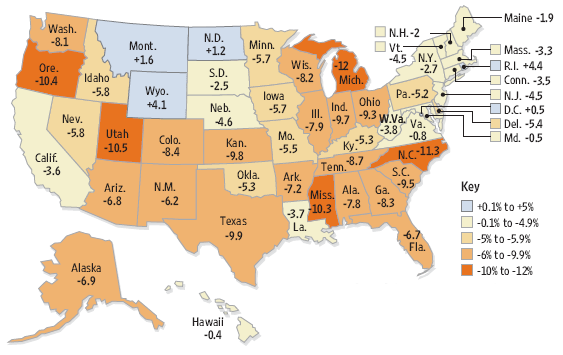
UPDATE: Turns out this map is wrong. That's what I get for believing a newspaper though. The correct figures can be found here. Kevin Drum provides an analysis here. Still lots and lots of red ink.

Here’s how brazen Mr. Rumsfeld was when he invoked Hitler’s appeasers to score his cheap points: Since Hitler was photographed warmly shaking Neville Chamberlain’s hand at Munich in 1938, the only image that comes close to matching it in epochal obsequiousness is the December 1983 photograph of Mr. Rumsfeld himself in Baghdad, warmly shaking the hand of Saddam Hussein in full fascist regalia.

"And one reason we enjoy it is that we're good at it. You know why we're good at it? Because we get alot of practice. This country is only 200 years old, and already we've had ten major wars. We average a major war every twenty years, So we're good at it!
And it's just as well we are, because we're not very good at anything else. Can't build a decent car anymore. Can't make a TV set, a cell phone, or a VCR. Got no steel industry left. No textiles. Can't educate our young people. Can't get health care to our old people. But we can bomb the shit outta your country, all right. We can bomb the shit outta your country!
If You're Brown, You're Goin Down."

But al-Qaeda won't be beaten by fighting a bunch of aimless proxy wars in the general vicinity of the Middle East. It will, eventually, be beaten when the non-terrorist population of the region decides to turn against al-Qaeda and its jihadist allies and deny them the support and shelter they need in order to function. Encouraging that to happen is the biggest foreign policy challenge of the 21st century, and because they've failed so miserably at it, it's the one thing the Bushies most want to avoid talking about.
But did he really do it? Well, he had a motive: As the paper and others have noted, Stevens and Coburn have clashed before -- in particular over Stevens' now-legendary "bridge to nowhere." Coburn attempted (and failed) to block the $233 million boondoggle. And revenge certainly fits the senior Alaskan's m.o. "Stevens can play rough," the Seattle Times noted in June. "Despite denials from his staff, he retaliates - and doesn't mind waiting years to do so."
 Statue comes alive.
 Get inside a bubble
 A very small portion of the midway
 Gary Puckett and the Union Gap
 BJ Thomas
 10 days old
I imagine in the not too distant future, Ph.D. dissertations and classes in political science will be devoted to analyzing how this crop of neocon miscreants lurched clumsily from one monstrous failure after another, and still held solidly onto a third of the electorate. Maybe the academics will figure it out. Part of me hopes someone will. For now, as one who has lived it, I find the phenomenon incomprehensible. When a co-worker defends Bush or Iraq or the handling of Katrina, I have to consciously try not to stare in open contempt, jaws agape, as a half dozen possible explanations for why they could be so sadly misled and yet so confident, wrestle with one another in the small part of my brain that insists on finding order in chaos.Read more here.
Apologists for the administration will doubtless claim that blame for the lack of progress rests not with Mr. Bush, but with the inherent inefficiency of government bureaucracies. That’s the great thing about being an antigovernment conservative: even when you fail at the task of governing, you can claim vindication for your ideology. But bureaucracies don’t have to be this inefficient. The failure to get moving on reconstruction reflects lack of leadership at the top.
Mr. Bush could have moved quickly to turn his promises of reconstruction into reality. But he didn’t. As months dragged by with little sign of White House action, all urgency about developing a plan for reconstruction ebbed away.
Mr. Bush could have appointed someone visible and energetic to oversee the Gulf Coast’s recovery, someone who could act as an advocate for families and local governments in need of help. But he didn’t. How many people can even name the supposed reconstruction "czar"?
Mr. Bush could have tried to fix FEMA, the agency whose effectiveness he destroyed through cronyism and privatization. But he didn’t. FEMA remains a demoralized organization, unable to replenish its ranks: it currently has fewer than 84 percent of its authorized personnel.
Maybe the aid promised to the gulf region will actually arrive some day. But by then it will probably be too late. Many former residents and small-business owners, tired of waiting for help that never comes, will have permanently relocated elsewhere; those businesses that stayed open, or reopened after the storm, will have gone under for lack of customers. In America as in Iraq, reconstruction delayed is reconstruction denied — and Mr. Bush has, once again, broken a promise.


